Showing posts with label photography. Show all posts

Making The Wild Huntsman

In spring of 2021, as lockdowns were starting to ease in Norway, and after having spent the previous year writing my first novel, I felt the need to flex my filmmaking muscles again and decided to make a short Fantasy film. Equipped with a meagre budget of roughly 10,000 NOK (the equivalent of about $900 or £700) and not much else—I was pretty much on my own and had little to no experience with the small film culture that exists on the Norwegian south-west coast around my hometown of Stavanger.

Inspired by the English folktale of the Odinic character Herne the Hunter, I quickly wrote a simple script and set out looking for my cast and crew.

My biggest stroke of luck was when I come in contact with actor and model Thor Rosland, who is generally known for his commercials for The Beard Struggle, in which dressed as a Viking, he promotes a series of beard oils and grooming products in comedic skits which had become something on an online sensation.

And with the upcoming release of The Pendragon Cycle, in which Thor plays Hengist, the warlord of the Saxons, this seemed like a good opportunity to reminisce a little about my short film with Thor; The Wild Huntsman.

Thor Rosland as The Huntsman. Photo © Kornelius Kiil Enoksen.


THE PREMISE

First off, I should probably explain in more details where I got the idea for the Huntsman and why I chose to make a short film out of it. 

I’ve always been fascinated by fairy tales, folk stories and myths from across the world. I'm especially fascinated by symbolic archetypes, doubly so when they appear across borders in the myths of neighbouring cultures. So, while looking for inspiration for my script, I came across the Danish/German folk tale of "The Fairy Hunter," a simple story about a hunter that kills an elf-girl (note that elf in this case refers to a more mischievous fay-like creature rather than the noble elves popularised by books/films like Lord of the Rings). Shortly after I came across the British legend of Herne the hunter, an antlered huntsman who is believed to be an incarnation of both the Celtic god Cernunnos and the head of the Norse gods; Odin—the latter of which is also the leader of the Wild Hunt. With these two simple stories in mind, I decided to combine them and create my own little cross-cultural archetype myth.

Thor Rosland as The Huntsman. Photo © Kornelius Kiil Enoksen.

The simplicity of both stories also made them perfect for my meagre budget and resources. I knew that my hometown of Stavanger could provide me with plenty of beautiful nature scenery befitting both folk tales, but also a perfect replica of an Iron Age farmhouse. I contacted the owners early on in the production and received permission to shoot parts of my short there, as well as borrow some of their period-accurate costumes.

I was off to a good start.


RALLYING A CAST & CREW

The lead (different from the titular character) proved to be the most difficult to cast as I required someone fairly young but who still had a Viking-quality to his appearance. The casting of Thor as the Huntsman had been something of a lucky stroke, and all the characters (despite there only being four) proved difficult. Stavanger simply isn’t a place with that large a film industry or acting community, and the fact I was producing a micro budget short film and was only offering to cover expenses didn’t exactly help much either. 

All attempts at casting the lead led me to an assortment of Oslo actors that had to be rejected due to the travel costs, though I eventually got into contact with Vegard Heggelund, a young actor with a proper Nordic look to him who, despite living and studying in Oslo, was actually from Karmøy—a large island not far north of Stavanger. It just so happened that he was planning a visit home for the summer holiday and he was more than willing to sacrifice a weekend for this project provided I could cover the cost of the relatively short trip down to Stavanger and accommodation, a request I was more than happy to oblige.

Actor Vegard Heggelund. Photo © Kornelius Kiil Enoksen.

The shooting crew consisted of three media students from the University in Stavanger, a somewhat meager number for a film shoot but perfectly serviceable for a small project like this—it's worth mentioning that I have worked with less in the past, though I wouldn't recommend it. Still, it was an odd adjustment after having recently spent some time in London with film crews of at least a dozen or so people (which is still quite small). 

At the risk of sounding like a money pincher, I've found that you can save a lot of money by "hiring" students as they are usually more than happy to get the chance to add any project to their CV before they've even finished their education. I also got the camera equipment for free via the university as I had borrowed from them before, so they knew I was someone who could be trusted with their equipment.

A small but very efficient film crew. Photo © Kornelius Kiil Enoksen.

The on-set photographer; Kornelius Kiil Enoksen, (whose excellent photos I’ve used throughout this article) is a friend of mine from my days studying Media & Communications. The rest of the crew consisted of pretty much every family member, friend, or friend-of-a-friend that I could convince to spend a weekend in July hanging out in a park while the rest of us were running about within the nearby woods getting our shots.


ANTLERS, SPEARS & COW TAILS

In the same way that digital cameras have become a godsend for the low budget filmmaker (though I do love analogue film), so has Etsy for the micro budget prop-maker. 

You’d think the Huntsman’s antlers would have proven to be the most difficult part of the pre-production—and in a sense it still was—but after some brief online searching I came across someone who made realistic looking horns and antlers for fantasy cosplayers. As luck would have it, she was also Norwegian, albeit living in Oslo, but after contacting her and explaining what I needed she was more than willing to make me some custom antlers with strengthened supports for the production. 

Etsy also provided me with a pretty convincing ancient-looking spearhead made from fiberglass and polyester resin, as well as the Mystery Girls’ animal appendage. One learns many strange things while working on projects like this, and the fact that you can buy real cow tails online is one of those things that really shouldn't surprise you, but receiving one in the mail is a whole other thing.  

Vegard Heggelund mending a prop between takes. Photo © Kornelius Kiil Enoksen.

The more “normal” props, such as a mediaeval fishing rod, I constructed myself. There’s not much to say about the making of the rod, it’s about what you’d expect, a bit of whittling, some twine, glue, etc. and the bone hooks were fashioned out of clay. But the one thing that I am quite proud of about this prop is just how historically accurate it turned out to be. No fishing rods have ever been found by archaeologist in Scandinavia, though based on the numerous discoveries of hooks made from deer bone it is safe to assume that they were used during the Viking Age. The simple rod I made was based off recreations of English fishing rods from the Middle Ages, but only a year or so after the film’s premiere I went to the Archaeological Museum in Stavanger and saw an exhibition of experimental recreations of bone hooks, and I was pleased to see that they looked virtually identical to my fake ones.

A few weeks before the shoot I met Thor in his home for a costume fitting and to try out the newly arrived antlers from Oslo. 

When it came to the costume for the Huntsman, I chose, both for practical and thematic reasons, to do the complete opposite that I planned on doing for the main character (the "Young Viking") and his family, and ignored historical accuracy completely. The practical reason for this was, of course, primarily because Thor could provide his own costume, which was more Hollywood inspired than anything based on history or archaeology. But because I knew the Huntsman would have to stand out and appear otherworldly when compared to the more "normal" characters, the exaggerated costumes he used for his Beard Struggle commercials fit perfectly, though admittedly I did end up choosing the most down to earth pieces he had in his wardrobe. Being a mythical creature that is part of the natural order I felt the brown leather gave him a suitably “earthy” look, while the fur around his shoulders complimented the animal-hybrid look of the antlers, making him appear somewhat elemental. 

Thor Rosland putting on his costume. Photo © Kornelius Kiil Enoksen.


THE IRON AGE FARM

To paraphrase what I wrote in a previous blog article (The Locations that Inspired The Starseed); Just a few kilometres uphill from the inlet where Harald Fairhair united the tribes of Norway into a single nation after the battle of Hafrsfjord in 872 AD, a trio of carefully reconstructed Iron Age longhouses lie in the shadows of three brutalist apartment blocks from the mid-1970s.

I’ve been coming to this location semi-regularly since childhood (I even spent a night there as a Boy Scout) and have always been fascinated by the feeling of being transported back in time when visiting, that is, as long as you look away from the aforementioned apartment blocks, or the nearby visitors centre, and if you look south you can pretty much see the entirety of the University in Stavanger, but, if you point your camera in the right direction, or simply stay within the longhouses, then it really does feel like you’ve travelled back to the Iron Age. And that’s exactly what I ended up doing.

Setting up a shot at the Iron Age Farm in Ullandhaug. Photo © Kornelius Kiil Enoksen.

As mentioned, I had contacted the manager of the Iron Age Farm early on in the project and I quickly received permission from her to shoot in and about the open-door museum, that is, provided we arrived before opening time, so as to not crash with any potential visitors. We were also given permission to pick out some of the authentic period-costumes they had for Vegard to wear throughout the shoot (even when not filming on the site) and we were told that the shoot would be overseen by one of their regular hosts—in costume no less. They were, however, somewhat vague on who exactly would be there when we arrived for the shoot, but assured me that whoever they were, they wouldn’t mind being on camera. So, I adjusted the script slightly by adding a brother/sister/mother background character, depending on who actually did show up.

We arrived early in the morning on June 26, having pretty much just a little over an hour to prepare and shoot everything we needed before the tourist would start arriving. We were greeted by a young woman in a period accurate dress named Johanne, and as such the main character ended up with a sister. Vegard was taken to the costume room and quickly fitted with his costume, while actor Pål Gunnar Eid Gribbestad, who played his father, provided his own costume. 

Pål Gunnar Eid Gribbestad inside the Iron Age longhouse. Photo © Kornelius Kiil Enoksen.

The host proved very enthusiastic about the project and lit a fire within the largest longhouse. She even dropped by the kitchen in the visitor centre café to get some fish to cook on the stone plate to add some domestic realism to the film's opening scene. She had no qualms about being on camera and even ended up becoming the first character we see in the finished film. Lit primarily by the fire (and a flickering red LED light), the opening shots of Johanne and Paul Gunnar are, I think, some of the best in the film. 

All went according to schedule, and we managed to wrap up just as the doors officially opened on the Iron Age Farm. While the film crew began carrying all the camera equipment away from the longhouses towards the visitor centre a small group of period-dressed hosts crossed us going in the opposite direction carrying wooden swords and other replicas of Iron Age implements meant to entertain and educate visitors.

Vegard Heggelund. Photo © Kornelius Kiil Enoksen.


THE LAKE AND THE FOREST

The rest of the film was shot around a small lake called Lille Stokkavann (lit: Little Stokka Lake) a short walk from where my mother, aunts and uncle grew up—I even spent part of my own childhood here, so it was very familiar territory.

When we arrived at our "green room," a nearby barn turned into a community centre, the rest of the crew had already unpacked and were waiting for us. We shot everything needed around the lake that day, as well as a long sequence within the nearby woods which in the final edit was cut down to a mere two shots. That’s filmmaking for you.

Discussing the scene with Vegard Heggelund. Photo © Kornelius Kiil Enoksen.

We returned to the same location for the second day, this time being joined by Thor Rosland, and spent the entire day within a small clearing close to a well-travelled gravel footpath hugging the edge of the lake. The crew of friends and family kept watch while the rest of us were working within the forest, informing joggers and people simply out for a stroll that there was a shoot going on. Most people were quite polite and passed by quietly, though we did receive a fair number of curious onlookers peeking at us through the bramble. Hardly surprising really, it’s not every day you see a large Viking with antlers while walking your dog. 

I had originally planned to use a smoke machine for this sequence to add a haunting, mystical atmosphere to the already picturesque forest clearing, but although I had acquired one via the university and had successfully tested it in the studio there a few days earlier, once we set it up in the forest, with a portable battery, spare fluid and everything, the little box-like machine merely sputtered out a few wimpy whisp of smoke and refused to give us anything else. 

Vegard Heggelund & Thor Rosland between takes. Photo © Kornelius Kiil Enoksen.

While irksome, the smoke machine was hardly necessary to finish the scene, even if I did loose much of the mythic aura I wanted to convey. At least the lights worked as intended, and I could console myself by getting a chance to play with some coloured gels for the first time, something which I learned a lot from and intend to continue to do in future film projects. I may have been denied my smoke, but I did succeed in using the unnatural green lighting as a means of conveying that there was something otherworldly about this forest and its two supernatural inhabitants.

Once the broken smoke machine had been ditched the shoot went quite smoothly, that is as smoothly as a shoot can be when an actor is forced to wear wobbly antlers on his head inside a dense forest, but apart from the logistics of shooting everything out of order (more so than usual) there were little to complain about, that is, except for the poor actress playing the Mystery Girl, who, unlike the two men, wore a pretty skimpy dress that made her an easy target to a swarm of very persistent gnats. I later learned she’d been bitten quite often, but she had merely soldiered on and finished the shoot with very few complaints.

Directing a scene with Thor Rosland. Photo © Kornelius Kiil Enoksen.


THE MYSTERY GIRL

Now, unless you're a Scandinavian, or just so happen to be well-read on Nordic folklore, you are probably not familiar with the creature that the Mystery Girl is revealed to be at the end of the short film. Although certain liberties have been taken with this myth, most Scandinavians watching the short will instantly recognise her as a Hulder (or Huldra) the moment her cow tail is revealed.

The Hulder is for all intents and purposes the Nordic equivalent of a siren or nymph, i.e. a seductress that leads men to their doom by enticing them to follow her into the forest.

Shooting a scene with Helen Sertsu. Photo © Kornelius Kiil Enoksen.

As with most folklore it’s hard to pin down the exact nature of a Hulder, though they are consistently depicted as young, beautiful blonde girls with a cow’s tail (which they usually try to hide). In many stories they also have a large hole on their back described as resembling a rotten tree stump. My Hulder obviously deviates a fair bit from much of this, the back-hole simply because it wouldn’t have been doable within the tiny budget (and frankly I don’t see what the point of it is beyond being weird) and although I originally intended to cast a Norwegian actress with blonde hair, actress Helen Sertsu was chosen due to her enthusiasm for the project and her availability. With this change in ethnicity, I decided to update the originally planned costume from an Iron Age dress to something more Mediterranean, specifically a Greek-inspired Khiton dress, implying that this creature in human form did not solely prey on Scandinavians, but had been chased by the Huntsman across multiple countries for who knows how many centuries. I also added additional details to her costume to further imply this long history, such as an amber necklace which suggested she had been in central Europe, a Celtic broch attached to her belt, and I even had some silver thread worked into the hem of the dress to add a subtle anachronism that made her seem just a little out of place in the “real world” of the Young Viking. 

Helen Sertsu. Photo © Kornelius Kiil Enoksen.

POST-PRODUCTION & RELEASE

The post-production phase proved to be somewhat more international than the shoot. The music was composed by Swedish artist Zacharias Wolfe, whom I had first heard of via The London Film Academy, and “Yggdrasill,” the song which plays over the end credits was licensed from Dutch singer and songwriter Jonathan Barendsma, AKA Gealdýr. The visual effects were done by Guilherme Filipe, while the rest of the process, such as film editing, colour grading, etc. was either done by myself or Kevin Nordlander (who was also the Assistant Director).

The Wild Huntsman had its premiere in the US, February 18, 2022, at the Pensacon Short Film Festival in Pensacola, Florida.


Making the Book Trailer for The Starseed

NOTE: This article references the full-length book trailer for The Starseed in a way that assumes you are already familiar with it. If you have not seen it, or if you'd like to re-familiarise yourself with the video, you can do so by clicking HERE.


INTRODUCTION

My biggest passion as a creative person has always been filmmaking. Although I did write fiction as a child, I was not much of an avid reader until later, and once I started making amateur films with my friends at age 12 it quickly became apparent to me that I wanted to be a filmmaker.

Of course, filmmaking, even in its simplest form is still an expensive and labour-intensive process requiring a fair amount of people, and the fact that I’m drawn towards sci-fi, fantasy and historical fiction hasn’t exactly made things easier.

In this case literature has been a real blessing for me. Granted, making a novel isn’t exactly free, especially if you want it to be up to professional standards. Though in the case of The Starseed I managed to save some money by designing the cover myself—one of the many benefits of a Media & Communications education. But, compared to a making a film, writing a novel is about as financially freeing as it can be, and you are only limited by your imagination. There are no actors’ fees, no location permits, no props, no sets. If you can write it, the audience can (hopefully) imagine it.

Of course, a book still requires some marketing if you want people to become aware of it. So, I decided to put some of my filmmaking skills to good use and make a book trailer. Most trailers that are out there, even the “professional” ones, are in my opinion, quite lacklustre, often relying on bland stock footage. I wanted to make something that would stand out.

THE CONCEPT

I was still working the novel when I started work on the trailer (final rewrites, spell checks, fact checks, that sort of thing), and not wanting to distract myself too much from finishing the very thing I was going to market, I decided to avoid anything that could accidentally turn it into an expensive short film. I therefore decided to make the video entirely out of still images, something which also had the added benefit of making it unlikely that it would be mistaken for a trailer for an actual film. Stills of real people and locations would provide me with a certain degree of authenticity, but it would be different enough to not give a false impression of the “product” I was advertising.

Naturally, as often is the case with any creative process, I started with many different ideas, some good, some bad, not to mention some very ambitious, until out of discipline and, unfortunately, in some cases, out of plain bad luck, I eventually managed to whittle it all down to something simple and surmountable.

GOING ANALOGUE

I have always been a sucker for the analogue aesthetic. Digital technology has served me well in the past (and still do), and I would not have been able to do most of my short film work without it, but there is simply something special about celluloid film. I have been fortunate enough to have shot one of my short films at the London Film Academy on super 16mm film, and I very much hope to one day be able to upgrade to full 35mm film as I genuinely see it as the superior medium for filmmaking. There is simply a richness to the colours, a depth in the collection of silver crystals, a sharpness of the interplay between light and shadow that simply cannot be fully emulated digitally. Of course, digital video has reached a level of quality that makes it a more than worthy alternative, though I am adamant that it is not a substitute.

However, for this book trailer 35mm film provided me with several benefits, and in this case it did admittedly have very little to do with image quality. Here it was simply a case of instant authenticity. I have several SLR cameras, all of which belonged to my mother, ranging from the simple to the complex. For practical reasons I went with complex and chose to use two Canon SLR cameras from the late 80s. Not entirely authentic to 1975, but I did not want to risk anything going wrong with the “cheaper” cameras from the 70s. I knew I would have to be economic with my 35mm film, though my initial, and frankly naïve, assumption that I could pull off the entire trailer with just one roll of film quickly escalated to four.

My Canon EOS 650 & Canon EOS 5 cameras.


FINDING PROFESSOR KORRIGAN

I had originally planned to find local actors, models, or just anyone who was willing to be photographed, to portray all of my main characters, not just Professor Korrigan, but Marshall, Hagen, and even Bergström as well. Suffice it to say that this didn’t work out, so I was forced to simplify things to just Korrigan.

That solved three problems, but still left me with the most important one, and a big one at that; where do I find someone in the Stavanger region that looks like an English professor with an Imperial moustache? I actually considered buying, or even commissioning, a fake moustache at some point, but I was sure that I had seen someone with an appropriate moustache locally. But where? And when? I searched and I searched, and at one point, through a friend who knows a lot of interesting people, I seemed to have found a near-perfect match; a true anglophile who could provide me with not only the moustache, but tweeds, hats, pipes, the whole works. Unfortunately, he had just taken ill and declined my offer. After more futile searching I decided to call someone I knew personally. He was a far cry from the dandy Englishman I pictured in my head, but he did have a moustache that was close-enough, and being a local actor who worked for a revue he could provide me with his own costumes. I asked him and he was willing to take some time off to pose for me. I counted my blessings. At that point I considered this a huge victory in a project that had been nothing but setbacks and compromises.

Though I was, and still am, extremely grateful for his willingness to support this project, I must admit that the end result was such a far cry from what I had imagined while writing the book that I somewhat despondently carried on with the project worrying that the first official depiction of my new recurring character would be so unfaithful to the book—and done by myself no less! Shortly after, however, my salvation finally came in the form of a poster.

Some crude "storyboard" sketches for the Professor Korrigan photoshoot.

Every year, in the town of Bryne where I live, they have a festival called Potetfestivalen (literally translates to “The Potato Festival”), and at the very top of the posters littered all over the town to inform of the upcoming activities I saw a photo of a man that immediately made me think; “that’s Korrigan!” Granted, an English gentleman like Korrigan would never be caught dead wearing a plaid shirt and a baseball cap with a picture of an anthropomorphised potato on it, but the slim face, the hawk-like nose, the dark-grey hair, and of course, the moustache, was perfect. With some help from the people running the festival I managed to track down the man on the poster, contacted him, and was thrilled to hear that he was willing to be the face of Professor Korrigan.

His name is Arne Vagle. He is a specialist in grains and potatoes working for the Norwegian Agricultural Advisory Service in Rogaland, and once I had learned of who he was, it quickly dawned on me that I had seen him many times before and that he was most definitely the moustached local man that I previously alluded to. It turns out that Vagle has been present at every Potato Festival since its creation in 1998, where he always presents a colourful assortment of different kinds of potatoes. Although I am admittedly not much of a connoisseur of potatoes, I had definitely seen him at the festival before and had clearly made some mental note of his distinguishable stache that had partially reemerged at the start of this project.

I met Vagle at his office and decorated one of the walls there with a cheap green tarp I had bought the day before to imply that he was sitting within a tent as a part of the archaeological excavation described in the book’s first chapter. After I had snapped a series of photographs here, I asked him if there was a basement or something to that effect that could be used to represent the machine room of the LNG tanker from the opposite end of the book, and he took me down to a locker room with a large metal cabinet and some air vents that that made for a passable backdrop. These photos, taken more-or-less in the dark, came out a little fuzzy, but that only enhanced the moody and grimy look that I wanted.

Two unused photos of Arne Vagle in costume.

There’s not too much to say about the costume Vagle wore. The tweed jacket I found at a 2nd hand store, and the rest was common enough. The pipe and the potsherd on the other hand are both very special and carry a bit of personal history.

The pipe belonged to my great grandfather and has been in the possession of my mother ever since he passed away in the 1970s. In fact, he had several pipes, two classic bent apple ones, a steel tipped jet pipe, and a foldable vest-pocket one for travel. I chose one of the two classical ones, favouring the one with the most noticeable signs of use as it seemed the most suitable for my well-travelled professor.

The piece being examined by Korrigan is part of a collection of real Native American potsherds found in the Arizona desert by my mother in the early 90’s shortly before I was born. Most of these sherds, which have always been on display in my mother’s living room for as long as I can remember, wouldn’t pass for Viking-era pottery, so I chose one of the most neutral ones. My mother, like myself, has always been quite fascinated by history and archaeology, so when I showed her the original photos I took she quickly reminded me that an expert on ancient pottery would focus on the cross-section of the rim in order to determine the overall shape and size, and thereby also the style and era, of the original pot. So, when I later handed the piece to Vagle, I made sure to relay this information to him.

My great-grandfather's pipe and my mother's collection of Native American potsherds.


BUILDING A CRIB ON A BUDGET

I knew early on that the ominous note left behind in the crib by the eco-terrorists would be an important visual motif in the trailer, so it was clear from the beginning that I would have to recreate the photo that Special Agent Marshall hands Professor Korrigan during their first meeting at the start of the book.

The note itself wasn’t a problem, and my mother provided me with the little teddy bear you can see in the top left corner. But what about the crib itself? I didn’t want to spend time and money buying a whole crib, let alone a vintage one, just for a single photo. The answer was a clever no-budget solution I had picked up at the London Film Academy. For a scene set in a prison cell, the director of photography had the clever idea to create the illusion of a barred window by stretching some black electrical tape over an empty frame that we held up to the light, thereby casting long vertical shadows over the actors. For the trailer photo I simply put a bedsheet over a rectangular foam pad, placed the note, the teddy bear, and a blanket that my mother had kept since I was a baby on top of it, then held a metal frame with a few rows of black tape in front of the window on a bright autumn day and snapped my photo.

Rejected photo where the illusion of a crib doesn't quite work.


AN AMERICAN CAR IN NORWAY

I also wanted to actually show the arrival of Marshall at the excavation, the latter of which I knew would have to be represented with a simple stock image which I eventually acquired through the archive at the University in Stavanger. As for the agent himself, since my original plan to include several actors/models never panned out, I decided instead to emphasise the mystery of the situation and figured that his foot stepping out of the car would suffice. The foot, if you were wondering, is mine.

But what of the car? I had a foot (and one to spare), I had some reasonably appropriate footwear, and I could easily find a rural spot to shoot the scene in (there’s plenty of those in Jæren), but you might think that vintage American cars aren't exactly something that everyone has in their garage. Lucky for me, however, I live in the Norwegian countryside, a place practicality riddled with American car enthusiasts. The largest organised group is called Amcar (quite simply short for “American car”). I contacted the local branch and gave a general sense of the type of car I was looking, deciding that this was not a time to be picky about exact models.

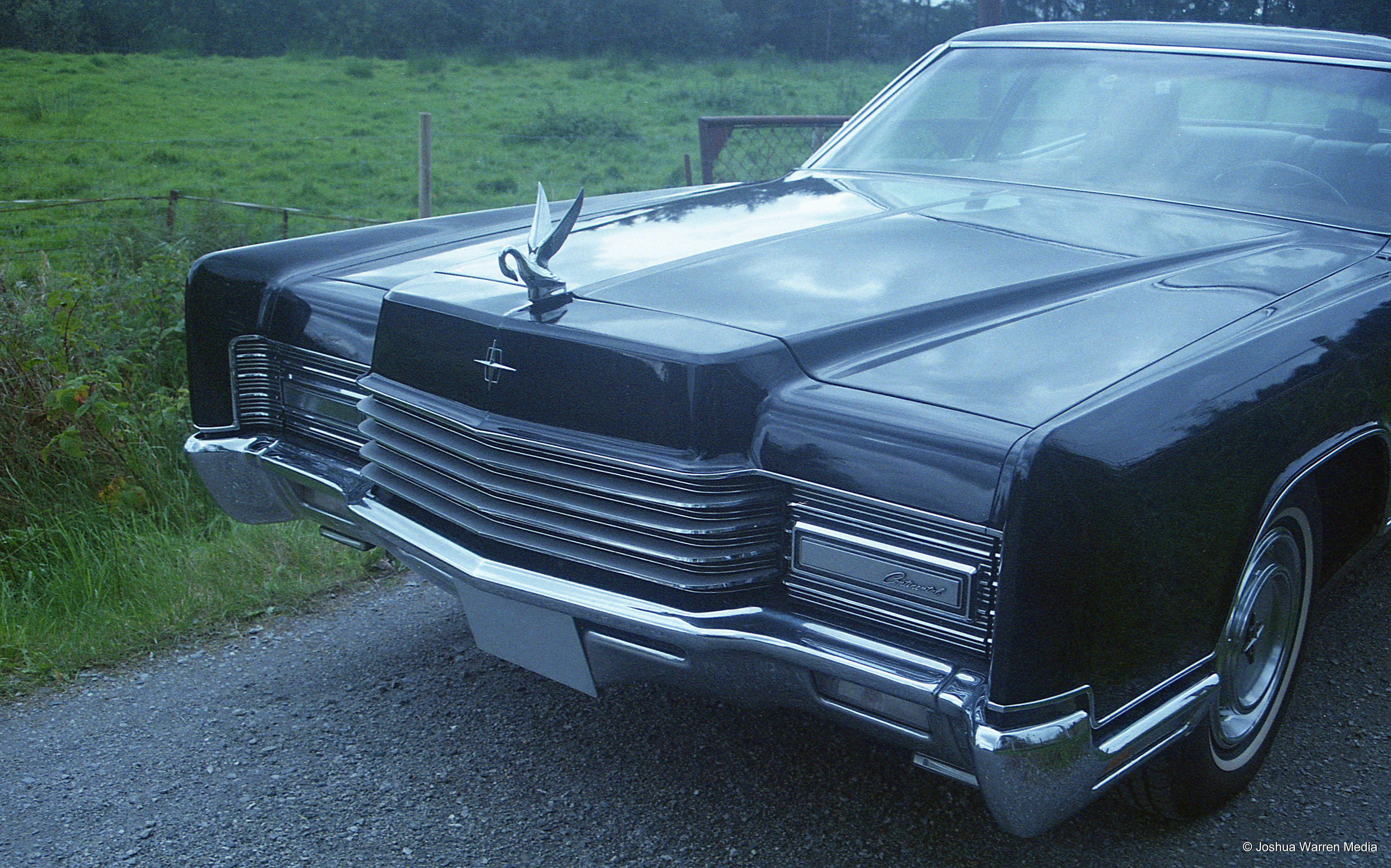
I eventually met up with Terje Tytland, the owner of a beautiful 1970 Ford Lincoln Continental. Though fairly different from the Chrysler described in the book, it did have that elongated and blocky silhouette that just screamed early 70s. If Marshall hadn’t gone for the Dodge Polara, this might have been his second choice. So, on an appropriately overcast day we took the car out to a country road where I snapped a few pictures of the car and he snapped a few of me stepping out of it.

A closer shot of the Ford Lincoln Continental that was not used in the trailer.


OILY GEODES

The meteorite shown in the trailer was another lucky no-budget solution. In 2008, while visiting some friends in the US, we went geode hunting in a stream in Illinois. During the drive we were given a rundown of what we might find—our “guides” had done this sort of thing many times before and had practically become experts—and explained that there were supposedly some geodes that contained raw oil, though they had never seen this. We hiked down to the stream, found several stones of varying sizes, cracked a few open, but one proved particularly tough, so we brought it back to our friends’ house and later that evening we took turns trying to break it open. The hammer passed from person to person, sparks literally flew from the rock as the hammer hit it, and eventually, as if it finally yielded to our curiosity, it neatly divided into two almost equally sized halves and a glob of black liquid splotched onto the pavement. It was actually filled with oil! You can still see dried up oil in the cracks of the odd, almost organic-looking interior of this strange geode, and we were told that the larger oil stain remained visible on the pavement for the better part of a year after we’d left.

Although the coarse, grey surface of this river rock is technically another incongruity with the novel, where it’s described as a smooth obsidian-like stone, it did fit most people’s preconception of what a meteorite should look like, and with its weird-looking interior revealed in cross-section, I decided to once again not squander a good opportunity with nitpicking.

The basement of my mother’s workplace just so happened to still have a bunch of furniture and random bits of equipment from the 70s and 80s scattered about, and provided a perfect backdrop for the scene where Bergström, also played by me, sneaks into the geology lab of the drill rig and places the stone on the table. Likewise, the rusty metal floor seen in the background when the stone is picked up (this time by my mother) was simply a small landing between two stairs near a restaurant a few blocks away from where I live that I felt had a nice industrial look to it. Yet another simple no-budget solution.

A normal river stone, a common geode, and a not so common geode. The black marks on the geode on the right are what's left of the crude oil.


THE CHILD

The last image seen in the trailer was actually one of the first things I photographed.

The solution was quite simple, though I must say, quite absurd looking in person. I purchased a baby doll from a second-hand store, got some black fishing line from a sports store, and I simply hung the doll from some air vents in the parking garage of the apartment building where I live. I suspended some black blankets with some old clothes hangers (and some tape) around one entrance to this little shortcut passage between two sections of the garage in order to block out the light from one side and to make sure that the bright light from the other would make the doll just a silhouette.

The end result was…passable. It was certainly strange.

But with some photoshopping it not only ended up looking quite retro, but had that surreal, X-Files inspired look that I was going for. In hindsight, though, there was so little left of the original aesthetic that I doubt if the B&W film made much of a difference.

Left: Probably one of the oddest BTS photos that has been taken of me. Right: The original B&W photo before it was photoshopped beyond recognition.


ODDS AND ENDS

Finally, just to be thorough, and in case some of you were wondering, here’s a brief explanation of the remaining photos that, in my opinion, didn’t have enough of a story behind them to warrant giving them their own section.

The house and the stairs representing the home of the kidnapped child were two separate locations, with the latter belonging to an artist friend of mine who not only lived in a house from the 70s but who collects all things odd and retro, such as the radio and the old Dole cardboard box that you can see at the bottom and top of the stairs. The house seen from the outside belongs to some old friends of my mother.

The stone circle is an actual pre-historic stone circle in Egersund which I have already written about in detail in my article about the Locations that Inspired The Starseed.

The two photos of the Aker H3 drill rig, and of the petroleum workers within, are historical stock photos generously provided by Norsk Oljemuseum (The Norwegian Petroleum Museum). 

And finally, though I did both the photo and the video editing myself, the rest of the post-production phase was largely done through people I know via The London Film Academy (the sound editing was done in Norway by Bibow Audio, who worked on both of my 2022 short films). The music was composed by Isabel Woodings, who was recommended to my by the co-producer and 2nd unit director of my short film Paradox, Oscar Hewitt, who on this project was also responsible for the voice-over recording.

The narration was done by voice actor David Mander, whom I discovered through an online casting process. The recording took place at the London Film Academy with Hewitt organising what can best be described as "long-distance-directing," meaning I directed the whole affair via Google Meet while Hewitt and Mander were together in the studio in London. Contrary to much of the analogue process used in the making of this trailer, this final step was a very modern solution that worked surprisingly well.


Featured post

THE STARSEED: A Professor Korrigan Mystery

  One night in 1975 a group of young men and women broke into a random house on the west-coast of Norway and abducted an infant child. A not...

Popular posts