Showing posts with label Professor Mortimer Korrigan. Show all posts

Connecting with the past through Roman clay lamps in an Iron Age longhouse


While attending a seminar on Museum Education at the Iron Age Farm (Jernaldergården) at Ullandhaug as part of my postgraduate studies at the University in Stavanger (UiS), I spotted something I had not expected to see; a replica of a Roman clay lamp. Although not temporally anachronistic (the original farmhouse had been in use between ca. AD 350–550), it was rather out of place geographically.

After having toured the largest of the three reconstructed longhouses—a locale I’ve become very familiar with over the years, both as a lover of history since childhood and as a filmmaker in 2021—I decided to ask our guide and instructor about the lamp. She agreed that it was a bit out of place, but as evidence of lamps from the period are quite scarce, and since the replica was based on lamps from roughly the right period, it had likely been included by the museum simply as a convenient prop to illustrate how people illuminated their homes in antiquity.

Note that the Iron Age Norwegians were hardly isolated from the rest of Europe, though, unlike the later Viking Age, trade with the Mediterranean was somewhat minimal. Still, the Archaeological Museum in Stavanger does feature large bronze pots with Romanesque designs from the same period, Roman glassware was also imported—presumably via Germany and Denmark—as prized luxury goods (a few examples from digitaltmuseum), and the occasional Roman coin do pop up every now and then. However, no one has ever found a Roman style clay lamp, at least not yet.

However, fascinating as all this was, I was (and still am as of the writing of this article) in the process of writing the second book in my Professor Korrigan mystery series, this time focused on the Roman occupation of Britain, and it just so happened that I was planning on writing a chapter where such a lamp featured. In this chapter, without giving too much away, Korrigan encounters what can best be described as a spectral artefact—or an ‘apport’ as it’s called in paranormal circles; a seemingly tangible but actually incorporeal object projected into the present from the past (quite fanciful, I know, but my last novel featured an extra-terrestrial substance, so why not?). As such it was in my best interest to get to know such objects as closely as possible in order to be able to convey to the reader all of the sensory impressions Korrigan would experience handling and studying this mysterious object. As a history student at the university, and someone already familiar to the museum staff—seeing as I literally borrowed the whole longhouse for a short film shoot just a few years earlier—I asked them if I might be allowed to have get a proper look at the lamp, and perhaps even get to actually light it. Despite the fact that the tour/seminar had been at the very tail end of the summer season and they were now officially closed for autumn/winter, they generously agreed to make a special appointment for me.

Killing two birds with one stone I had scheduled to meet with Inger Horve, the Operations Manager at the Iron Age Farm, just after a lecture at the university. The reconstructed farmstead is a part of the Archaeological Museum in Stavanger, which in turn is a branch of the University, and conveniently for me, just right up the road from my faculty on campus. I’d agreed to meet with Horve by the largest of the longhouses, but the lecture had finished early, so I was about twenty minutes ahead of schedule.

The Iron Age Farm (Jernaldergården) at Ullandhaug as you approach it from the old gate. Before the visitor’s centre was built in 2018 (now closed during the off-season) this was how you always visited the open-air museum. At least when you approach from the visitor’s centre (just out of frame to the left) you can’t immediately see the three (somewhat immersion-breaking) city blocks in the background. Photo taken November 2026. 

I approached through the old gate—not being able to enter by the now closed visitor’s centre—and passed about a dozen sheep, all quite accustomed to people and thoroughly indifferent to my presence. During the aforementioned tour that had inspired this whole visit a few weeks earlier, our guide and instructor, who had previously worked here as a museum host, introduced us to the two matriarchs of the sheep flock, whose names were Aud Jr. and Embla. As I zigzagged past the clusters of sheep droppings and made my way to the main entrance to the largest longhouse, I also recalled what she had told the group while we’d all gathered in the same spot a few weeks earlier. She’d pointed down at a white blotch on the ground and told us that this was the incriminating evidence left by Aud Jr. after a recent flour raid inside the longhouse; the result of a careless host having forgotten to close the door properly. Inside is a recreation of a hand-turned millstone that is used to demonstrate, especially to schoolchildren, just how labour-intensive it was to produce a simple loaf of bread in Antiquity. However, once the sheep discovered the joys of licking away all the excess flour produced by these demonstrations, they quickly became hard to keep out—especially Aud Jr., whom Inger Horve later described to me as the “ringleader,” and a bad influence on the other sheep. After she’d led us all into the longhouse, the last of us to do so, as per her instructions, had closed the door behind him to not let any sheep sneak in. A few minutes later we heard the muffled, annoyed bleating of a foiled Aud Jr. just outside the door. 

Back in the present I was about to knock on the somewhat modern-looking wooden door when I noticed it was open; a slight crack between it and the doorframe. I let myself in and found the place empty of both sheep and humans, though the lights were on. I couldn’t quite shake the feeling that I was intruding, but I did after all have an appointment. I’d never been inside without a tour guide or other tourists present, so I took the opportunity to have a look around and found the Roman lamp down by the now cold hearth, just as it had been previously. Now that I got a proper look at it in the light it was a lot greasier than I’d remembered, almost pitch black. It was sticky to the touch. When Horve arrived, right on time, I was pleased to see that she’d brought not only the wicks and oil as agreed, but a brand-new lamp for my little experiment.

The interior of the largest longhouse at the Iron Age Farm (Jernaldergården) at Ullandhaug. Photo taken November 2026.

For fuel she had brought a bottle of “Tran,” a brand of cod liver oil that most Norwegians have childhood memories of reluctantly downing as it’s a very popular dietary supplement rich in omega-3 fatty acids and various vitamins. Now this might seem like a bit of an odd choice for lamp fuel—and I was a little surprised myself when I first heard that this is what they commonly use in these lamps at the open-air museum. For context, in antiquity most people would have used olive oil; a commodity that was anything but scarce in the Roman sphere of influence across the Mediterranean during the height of the empire. Olives are, however, not exactly a common thing up here in the cold north of Scandinavia and certainly would have been completely unknown to the Norwegians of the Iron Age. Of course, my interest in these lamps was in relation to Roman Britain, though there too we encounter the same problem. In my research I found that, although olive oil was imported to the Roman occupying forces, it became something of a luxury commodity reserved for the elite. Since my story is focused on the Roman army, specifically the lower-ranking auxiliary troops, olive oil was therefore out of the question. Let’s not forget that olive oil is also foodstuff, so unless you lived at the heart of a wealthy city like Rome or Carthage where you could expect a fair amount of food surplus, you were effectively just burning up something edible. Doing some more research I found that there were several substitutes produced in Roman Britain, such as sesame oil, nut oil, castor oil and animal products such as fish oil. Since fish oil kept popping up in later Medieval British historical references as well, and since it was what the museum had on hand, I decided to simply go with the more practical alternative. I’d also read that fish oil lamps were quite malodorous and produced a smoky flame, all of which seemed to fit in well with my hapless auxiliary soldiers deployed on a cold and rainy island to the north to stand watch on Hadrian’s newly constructed defensive wall with the “barbarian” Celts waiting for their chance to strike back against the invaders on the other side. 

As you can see in the photos below these lamps come with a very convenient, recessed hole for pouring the oil into (the “dish” around it is called a discus, though this one was rather flat) and I quickly discovered how easy it was to overfill the lamp and ended up creating a little pool of oil. The wick that Horve had brought with her, which looked like a little shoelace, was made from very finely weaved wool threads. In antiquity such wicks would commonly have been made from scraps of linen, papyrus, or oakum. The matches I was given had been stored in the longhouse, and since this was in early November, they had gotten a little damp. As I sat there striking the same match again and again, barely getting a spark, I could imagine myself back in antiquity with a flint and tinder struggling to start a flame. Eventually I did get a flame going and lit the wick. Once the flame reached the oil in the nozzle (rostrum, literally “beak”) it lit up remarkably well. It was a surprisingly wild flame, completely different from the calm, gentle flicker of a modern candle. As expected, the flame produced a lot of smoke. Horve turned off the electric lights and, although a little daylight did seep in from some small openings in the roof, it was impressive how well it lit up my immediate surroundings. I brought out my notebook and found that I could easily read from it. The biggest surprise, however, was the smell. It was actually quite nice. It had a very fresh hint of lime to it. We checked the Tran bottle and found that it had been lime flavoured to be more palatable, and being such a modern product, probably didn’t give any indication of the foul smells I’d read about. I’ll just have to use my imagination for this particular detail when I describe it in my novel.

The light looks quite calm on this photo, but the wild, flickering flame, with its oddly extended smoky wisp was quite unlike any modern candle I’ve used. It felt appropriately archaic, though when contrasted with the rustic setting of the Iron Age farmhouse, it also felt quite modern and “civilised.” 

Horve had also brought with her the stems of some soft rush (juncus effusus), which, when peeled, produce a slightly spongy pith filling that can be used as a wick. In Norwegian this plant is called lyssiv, which literally translates as “light-rush,” suggesting a very old association with lamps. Incidentally, the Norwegian word for the cod liver oil, tran, comes from the Middle Low Saxon trān, which means “drop” or “teardrop” (NOAB). However, the Icelandic name for cod oil is Lýsi, and if we compare this to the aforementioned lyssiv, we have a word that sounds almost identical to the Norwegian word for “light.” In Icelandic Lýsi literally refers to something that provides light (Zoëga, 281), demonstrating that fish oil too has been a common lamp oil in this part of the world for a very long time.

In our case, though, the “light-rush” did not provide all that much light and the flame at the end of the spongy wick was quite small and dim. Horve figured the rush was a bit too damp for our experiment, though it did demonstrate that it was viable as a wick, even if our attempt went out after only five minutes or so. It probably didn’t help either that the original woollen wick used for this lamp had gotten stuck inside the lamp when the end of the wick protruding from the nozzle had burned away some time earlier. In antiquity a small needle, or specialised tweezers, were used to pull the wick out as it burned down to avoid this from happening.

The soft rush wick did work but provided a much smaller flame due to it having not been dried out properly. Some unpeeled rush can be seen lying in the background. The dark coating on the lamp is the result of several years of accumulative soot mixed with the overflow of fish oil. 

Trying to figure out exactly what type of Roman lamp the replicas were based on according to established typological classification proved a lot trickier than I’d expected, though they both seem to correspond pretty well with the Loeschcke type X lamps (or Buchi type X-a), often referred to as the “Roman Factory Lamp” and dating to around AD 90 to the end of the third century. These are generally identified by their lack of decoration, though Bacchic or comic mask motifs do frequently appear in the centre of the characteristically flat-bottomed discus. Another distinguishing feature is the raised rim that forms a channel all the way out to and around the wick-hole on the nozzle, not an altogether uncommon feature, but the sharp angles are very typical of the Loeschcke type X. So far so good. On each side, outside the circular rim, are two or three knobs, which on actual antique lamps are the remains of broken off rings used for suspending the lamp with chains. How exactly only two attachment points were supposed to suspend the lamp without it tipping over and spilling the oil out the nozzle beats me but looking at a lot of photos from museums I see that many of these lamps did indeed only have two attachment points. Either way, our modern lamp-maker has either added these knobs simply as an allusion to this historical suspension feature or may simply have been unaware of their exact purpose. What we’re left with are two vestigial dimples divorced from their original practical purpose. I’m glad I discovered this, as, when I was standing inside the longhouse, holding the lamp in my hand, I kept wondering what on earth these little knobs were meant for. They seemed a rather pointless detail to add purely for decoration, and I could find no practical reason for them as I held it in my hand, seeing as they did not provide a natural place for my fingers to rest either.

Two examples of Loeschcke type X, or “factory lamps,” from the Getty Museum, Los Angeles (public domain photos).
Left: Terracotta mould-made lamp decorated with a theatre mask design, Roman (Cologne, Germany), 1st–2nd century AD. Object Number: 83.AQ.377.441.
Right: Terracotta mould-made lamp, Roman (possibly North African), 1st century AD. Object Number: 83.AQ.377.444.

All in all, I feel it was a very successful experiment. Although I still have no idea how burning fish oil would have smelled in antiquity, and there are still certain details that needs to be ironed out for my novel, what started as a vaguely defined object I’d only seen in photos; with no real sense of scale, weight, texture, and actual efficiency, I now understand as a tangible, practical object.

This whole experience, even if it mostly just consisted of me fiddling with a couple lamps for about half an hour, and discussing history with a museum-educator, actually highlights really well the value of institutions such as The Iron Age Farm (Jernaldergården) at Ullandhaug, and open-air museums in general. For the past few years now I’ve been spending much of my time sitting in lecture halls, listening to historians talk about the past, and while this is certainly very valuable (and something I quite enjoy), it doesn’t do much to put you into the shoes of the people who lived in the past. You get a lot of interesting information but few tangible experiences to connect them to. But when standing in a dimly lit, slightly damp, chilly reconstruction of an Iron Age House, feet planted on well-trodden earth (the original excavated flooring by the way), and the only source of light you have is a flickering flame emanating from a small clay container you’re holding in your hand, you do get a certain empathic connection with the past; a feeling of presence. Of course, such props are just that, props, and not a true indication of the past, but it does concretise and bring to life an otherwise abstract past in a way that is educational on a much more tactile level than reading a book or listening to a lecture ever can.

And this is far from my first experience of this kind in this very building. As I alluded to earlier, I have been coming to this open-air museum fairly regularly since I was a child, and when I was nine years old, I actually spent the night here with a group of kids as part of a special arrangement. I got to taste bread made with flour grounded in the millstone and baked over a flame. It was surprisingly tasty, though the stone-ground flour did mean it was infused with grit; small particles of stone that ground against my teeth. Every bite into the otherwise soft bread had a slightly unsettling crunch to it. At that moment I understood why skeletons from this era always have noticeably worn-down teeth and why historians often talked about how they could identify someone’s approximate age by simply looking at how worn down the teeth were. If I had been eating bread like this every day my whole life my teeth would already have been in a pretty bad state as well. Likewise, sleeping on what effectively amounts to a wooden shelf with animal hides to keep you warm (though for practical reasons we did bring modern sleeping bags as well) and having a low flame crackling nearby, the flickering flames casting dancing shadows around the wooden support beams, is one of the most vivid experiences I’ve had in relation to my appreciation and understanding of history. And this kind of intuitive historical consciousness is exactly what places like the Iron Age Farm were made for.


Literature: 

Bailey, Donald M. Greek and Roman Pottery Lamps. London: British Museum, 1972.

Bussière, Jean, and Birgitta Lindros Wohl. Ancient Lamps in the J. Paul Getty Museum. Los Angeles: J. Paul Getty Museum, 2017. http://www.getty.edu/publications/ancientlamps (Accessed 04 November 2026). 

Walters, H. B. Catalogue of the Greek and Roman Lamps in the British Museum. London: Printed by order of the Trustees, 1914.  

Zoëga, Geir Tómasson. A Concise Dictionary of Old Icelandic. Oxford: Clarendon Press, 1952.


PS. For some much nicer exterior photos of the Iron Age Farm than the one I quickly snapped on my way up from campus, plus some more details about its history, check out my previous article The Locations that Inspired The Starseed.


Continuing the Professor Korrigan Mystery series

Today seemed like a good day to make a little announcement, as it were, since it was on this date (March 3), fifty years ago, in the year 1975, that the plot of my first Professor Korrigan Mystery novel began in a small rural part of southwest Norway, marking the beginning of his three day journey to solve the terrible secret of The Starseed.

However fictional these events may be, I'm using this pseudo-anniversary as an excuse to provide an update on the development of the series. Actually, I have two Professor Korrigan-related news I want to share.

Photo model: Arne Vagle. 

The first is that I am working on the second novel in the series. This new chapter in the life of Professor Korrigan will be set in Northumberland, near the Roman ruins of Hadrian's Wall, where the mysterious death of a respected archaeologist and the discovery of a strange, primitive stone figure sets him out on a horrifying new adventure.

Note that this is a different story from the one I have previously teased, both on my website and in the final pages of The Starseed. That project, which will be on a much larger scale (literally and figuratively) is one that I have already worked on for a while now, and will continue to do so. For now, however, I am deeply entrenched in the history of the Roman occupation of England in the 2nd century AD and the Celtic tribes that resisted them, both of whom will be at the centre of my new historical mystery. 

Now, despite having been busy with my university studies, I have already gotten well underway with the historical research for this new story. In fact, just this past week I had a long and fascinating conversation with a historian and former archaeologist at the University in Stavanger. I'll provide more details on this here on the blog when the book is released.

Photo taken during my visit to Hadrian's Wall (near Hexham) in 2022.

I also plan on publishing an updated version of The Starseed later this year (mostly likely early autumn). The story will remain exactly the same, but, having detected a few technical errors and minor historical inaccuracies, I have recently done some additional research and consulted with a few more experts in order to make sure that the factual parts of the story will be as accurate as can be. In addition, I will add a more detailed breakdown of my research (both old and new), which is something I intend to do in all future Professor Korrigan Mystery novels. A preview of my next book will also be added when this work is completed.

UPDATE (17 September, 2025): The revised edition of The Starseed have now been published. 

How Retired Policemen helped me Research The Starseed

I've previously written about some of the unique challenges that arises when writing about an archeologist, not only for the obvious reason that I am not one myself (though the subject has fascinated me greatly since I was a child), but also how I have had to force myself to focus my research primarily on "outdated" knowledge as any modern information found online would not be relevant when writing about a mid-20th century academic like Professor Korrigan. I wrote about this in another article titled My "Outdated Archaeology Library.

However, since The Starseed is primarily a crime story with elements of archaeology sprinkled in throughout, I was faced with the additional challenge of having to get into the specifics of Norwegian law enforcement in the mid-1970s, something which would never have been possible if not for a handful of people associated with The National Museum of Justice and The Norwegian Police History Society. In this article I would like to add additional thanks to these individuals while also explaining in further detail than what I did in the book's short acknowledgments section on how exactly they helped make my novel as authentic as it is.

The main entrance to the National Museum of Justice in Trondheim, Norway.
Wikimedia Commons photo by Wolfmann.


DIGITAL ARCHIVES AND THE MUSEUM OF JUSTICE

When I first started work on The Starseed I did what most people do when researching any given subject nowadays, I used Google. However, I quickly found that this was quite limiting. I have often found that the internet is rarely the best source of information regarding esoteric subjects, especially here in Norway. Now, if I'd have to solve similar issues related to law enforcement in say, the US or the UK, then it would likely have been a completely different story. The problem with Norway, however, is not so much that the information doesn't exist, but rather that there aren't enough people to allow the information to trickle on to the internet. The population is simply too small. In America, at least when compared to Scandinavia, there is simply no such thing as a niche. Even the smallest and most esoteric of niches, even if the percentage of the population remains as low as in Norway, you're still likely to find thousands, if not tens of thousands, or even hundreds of thousands of people within said niche. America does have a population of over 300 million people after all. Norway in comparison has only 5. 

So, when the internet failed me it became clear that I'd have to go directly to the source of the information that I wanted—which is a lot more fun anyhow. But where to start?

The extensive digital archives on digitaltmuseum.no proved an invaluable source during the writing process.

Now I must point out that I did have some luck with my online research, mostly thanks to the digital archives at digitaltmuseum.no where I found several photos of items belonging to the police from the middle of the 20th century. However, the labels weren't always too specific on precisely when these items had been used. They preferred to give very broad and general periods of use, usually measured in decades. I did however quickly find that all of them belonged to the same museum, The National Museum of Justice in Trondheim.

Now Trondheim is a fair bit further north in Norway from where I live and at the time going there in person wasn't really an option, but I now had a handful of vaguely labelled photos that I felt gave me a decent sense of what the police men in my current draft would likely have used and decided to contact the museum in the hopes that someone there could help me confirm or correct my assumptions. I've found that it's much smarter to ask for corrections rather than blank-slate questions that effectively boils down to "do the research for me." I quickly got a reply from Hilde Haaverstad Olsø, the collection administrator & conservator and she not only replied to my list of questions, she also forwarded my request to two individuals with direct experience in law enforcement during the period of my book's setting; retired Kripos investigator Oddmund Dahle & retired police superintendent Magnar Skaret.

Dahle was largely responsible for helping me confirm that my depiction of Kripos, both for The Starseed and a brief appearance in another novel I'm working on, was largely accurate. Although this book never goes too deep into Kripos operations, it was important to me that the character of Kripos Investigator Harald Hagen, and his function within the story, was completely in line with the duties and jurisdiction of Kripos back in the 1970s. Early in our correspondence it quickly became apparent that although my depiction of Hagen himself was quite accurate, I had overestimated the full range of Kripos' responsibilities and how they cooperated with other branches of the law. This forced me to make some necessary adjustments to the later chapters in the book where I depicted a police raid on the novel's antagonists, the Environmental Liberation Front (ELF) eco-terrorists. A bit more on this later.

All in all though, it was really interesting to get to exchange emails with an actual former Kripos investigator, something which I had not predicted when I began work on this novel.


TWO TOMES FROM THE POLICE HISTORY SOCIETY

Moving on from Kripos, it must be said that it is Magnar Skaret, a retired police superintendent & chief of staff from Trondheim, who deserves the bulk of the praise when it comes to my depiction of the Norwegian police in the The Starseed. Skaret went beyond simply answering the myriad of questions that I kept sending his way, he was also generous enough to send me copies of two books that he'd written for the The Norwegian Police History Society. Actually, calling them books don't do them justice, they are more like tomes.

After having corresponded with Skaret for a while it became clear to him that the information I was after went well beyond general information about police duties, but ventured into very specific esoterica, something which, thankfully, Skaret was very much the right man for. Of course, no one can be expected to remember every little detail about police equipment, uniforms, procedures, etc. so he concluded that the best thing to do would be to send me copies of the two books he had written and published at this point. What I received in the mail about a week later were two massive volumes dense with information on every imaginable detail related to their broad subject matters. I almost feel a little bad for having since left these two books lying on a shelf where they have remained largely untouched as I only needed a tiny fraction of the vast knowledge contained within.

Magnar Skaret with his book on police weapons throughout the years.
Photo by S. Aarsbog.

Where these books proved the most useful was for the aforementioned raid depicted towards the end of the novel. After having been corrected by Oddmund Dahle that Kripos would not have been directly responsible for such an operation, I had to figure out exactly who would have been the natural choice. Since Skaret had, among his diverse range of duties over the years worked with Beredskapstroppen, AKA Delta Unit, he recommended that I include them in the book. This did pose a bit of a problem as Delta Unit was not made operational until January 11, 1976, about ten months after the setting of my story. Int he end, however, I decided to bend the facts ever-so-slightly in my favour, and included them despite this minor timing anachronism. Yes, there was a somewhat similar unit present before called Østlandstroppen, though I never quite felt that this group had the correct training that was required for my fictional raid. Instead I decided to conjure up a secret early trial run of the unit, something which would have been quite plausible as the suggestion to form Delta Unit had been greenlit by the police in January of that same year. 

My depiction of Delta may not be 100% accurate as far as timing is concerned, but their uniforms, equipment, weaponry, and their overall function in the story is completely within the realms of reality had the unit been operational ten months earlier.


BIBLIOGRAPHY

Skaret, Magne. Fra Varde til SMS: Politiets Sambandshistorie [translation: From Cairns to SMS: The History of Police Communications.] Oslo: Norsk Politihistorisk Selskap, 2009.

Skaret, Magne. Politiets Våpen: Fra Morgenstjerne til Moderne Automatvåpen [translation: Police Weapons: From morning stars* to automatic rifles]. Oslo: Norsk Politihistorisk Selskap, 2017.

*In case you were wondering what a morning star is, it refers to several types of club-like weapons consisting of a shaft with a spiked ball attached to the top. These were quite common with the night watchmen ('Vekter' in Norwegian) that up until about 150 years ago patrolled the streets with only said club and a lantern. There's actually a well know statue in my hometown of Stavanger depicting one of these watchmen with a morning star in one hand and a lamp in the other (though the latter, minus the handle, was stolen many years ago). You can see a photo of watchman with a morning star on the cover of the 2nd (green) book below.

Skaret's tomes on police communications and weaponry.

I would also like to point out that Skaret recently added a third book to his bibliography, this time focusing on police vehicles titled Til lands og til vans og i luften med Politiets Transportmidler. While I was making the final adjustments on The Starseed and sending my final questions to Skaret (I think it was about Delta Unit communications) he informed me that he just handed in the final draft of this book, at over 600 pages. The book was published a few months later in early 2024 via NPHS.


I would like to once again thank Magnar Skaret, the late Oddmund Dahle (who passed away April 2024), Hilde Haaverstad Olsø, The National Museum of Justice and The Norwegian Police History Society for their help with my research for The Starseed.

My "Outdated" Archaeology Library

NOTE: This article is focused on an ever-growing bibliography and will therefore be updated at irregular intervals.


A selection from my collection of old history & archaeology books.


One of the most interesting challenges that faced me during the early stages of researching the first book in the Professor Korrigan series (The Starseed) was that I quickly realised that I couldn’t entirely rely on up-to-date archaeological research. After all, Korrigan's adventures take place around the middle of the 20th century, meaning that any advancements made in the field of archaeology (as well as our general knowledge of history) in the past several decades was not always usable to me. And scrubbing away recent advances in academia while doing my online research is difficult at best and impossible at worst. My solution therefore was an appropriately old-school one where I established a sort of personal library of “outdated” archaeology and history books.

One of my hobbies—if you can even call it a hobby (maybe ‘esoteric fascination’ is a more accurate description)—is to study how people in the past perceived the world around them. As a society we tend to quickly forget what we "all" believed yesterday and one of my biggest pet-peeves in movies and literature is when characters in historical settings talk, behave, and interact with the world around them in a manner that is comparable, or straight up indistinguishable, from the current zeitgeist. This is not simply anachronistic but it betrays the apathy and lack of genuine historical curiosity in the people responsible for such stories. I would also argue that there is more to be gained from getting a genuine glimpse into the past than it is to simply transplant “modern” thinking into a vintage setting.


IT STARTED IN OXFORD

This vintage library properly began its life at the University of Oxford during a research trip to the Archaeological Institute in 2023. I wanted to familiarise myself with Professor Korrigan’s Oxford stomping grounds and was given a quick tour of the building by Robin Mason, the Communications and Outreach manager at the School of Archaeology. During the tour we briefly passed a bookcase filled with mostly older research books during which she made a brief comment about how much more interesting the older book covers usually were (something which I very much agreed with), though I must admit that I took little note of it at the time. In my defense, though, my focus at the time was primarily on the building itself (and it is quite a complex maze of corridors and stairs to focus on) and I was at the time going through the final stages of a pretty bad cold I had been dealing with during my travels across both Norway and the UK during the past two weeks. 

Upon my return home, however, I quickly realised that I had missed a golden opportunity by not snapping a few photos of the bookcase, so I emailed Mason and asked her if she could take a few pictures for me. She happily obliged and within the next ten minutes after having received the photos I had already purchased several of them online.

The Institute of Archaeology at 36 Beaumont St, Oxford.


BOOKS VS THE INTERNET

I earlier alluded to how difficult it can be to find out-of-date research material online, but keep in mind that the process is barely any easier when trying to discover older research literature to purchase. The problem is that most algorithms are designed to give you the newest or most popular information related to your search words. I won’t go into how I feel that this trend can be problematic even when dealing with current, up-to-date information, but suffice it to say, in my particular situation, this function is completely antithetical to my goals. Also, simply Googling “old archaeology books” mostly just confused the algorithm as all archaeology effectively deal with “old” things anyhow. You need to give it specific titles or author names, but then you're back at square one; how do you find old books if you don't know what to look for to begin with.

[2026 addendum: this issue has become somewhat easier since I started my Korrigan-related research in 2022/2023, though even with modern algorithms, finding the right outdated research without too many specific parameters can still be somewhat tricky.]

Once again, the old-school method proved the most efficient one. With my reference point from the School of Archaeology in Oxford, I managed to branch out to several books and authors based on the references found within. What started with a few general history books have developed into a collection of often highly esoteric books, ranging from half-a-century old ordnance surveys to beginner guides that would have been used by university students in the 1950s and 60s, much like the ones Korrigan would have taught during his fictional tenure at the university.

Of course, libraries in general are, and have been, a good source of information for me, especially the library at the Museum of Archaeology in my hometown of Stavanger, and I cannot stress how important websites like archive.org have been for finding scans of rare and/or expensive out of print books, though I will limit this article to just the books that I actually own. 

In my case I think I'd have more luck with a card-catalogue than with Google. 
(Photo taken at the Institute of Archaeology, May 2023.)


DON'T UNDERSTIMATE THE WEIRD AND UNUSUAL

I also want to point out that one of the areas where I find that a lot of “modern” views can most noticeably get in the way of authenticity, is in the field of mythology and folklore. A lot of modern researchers have an unfortunate tendency towards a strongly reductionist view of the world that can often come off as dismissive and emotionally cold, though this has in my experience become less of a problem in recent years and, I must point out, have never been too big an issue among anthropologists and religious scholars. Granted, if you go too far back in time the research literature you'll come across is often be prone towards the exact opposite problem, i.e. blatantly unscientific and often flamboyant assumptions that dabble in the esoteric and paranormal. But, in the context of my fiction writing, rather than proper historical research, these eccentric interpretations can often be exactly what I am looking for. Yet another benefit of “outdated” research books.

A great example of this latter point is Sigmund Freud’s Moses and Monetheism. In this peculiar, but very fascinating analysis, the founder of psychology himself argues through psychoanalysis (naturally) that Moses was not only an Egyptian priest under Akhenaten, but that he was murdered by his semitic followers during the exodus. Freud proposes that through a long-remembered collective sense of guilt Moses was eventually elevated to the role of prophet as a form of spiritual atonement. Now, is this theory based on any scientific reasoning? Not really. But is it interesting? Definitely! And it is exactly the kind of odd thing that an eccentric researcher like Professor Korrigan might have found interesting.

It is important to stress that this collection isn’t only for my own fascination and private research into historiography, but an attempt to get into the headspace of the character of Professor Korrigan himself so that I can make him a more rounded and believable (not to mention more interesting) character.


PS. Since I'm a bibliophile geek, I naturally have my own Ex Libris book stamp. The design, which depicts Wotan (Odin), is taken from a 1910 edition of The Rhinegold and the Valkyrie illustrated by the great Arthur Rackham. This isn't strictly relevant to this article but when else will I get the chance to show off my personalised stamps—yet another of my old-school interests.  

Adding to the provenance of a book that has been through many owners over the years (including a boarding school). Much of my collection consist of former library books.


BIBLIOGRAPHY

Andronicos, Manolis. Delphi. Athens: Ekdotike Athenon S.A., 1982. 

Andronicos, Manolis. Olympia. Athens: Ekdotike Athenon S.A., 1982.

Blindheim, Charlotte., Ellen-Karine Hougen, Jon Høsøien, Arne Bjørn Thorbjørnsen, Henning Sinding-Larsen, Erik Lunde, Harald Brynildsen, Helge Ingstad, Anders Hagen, Sverre Marstrander, Alf Næsheim. Vikingtog og Vikingtid. Oslo: Chr. Schibsted Forlag, 1977.

Brodrick, M. & A. A. Morton. A Concise Dictionary of Egyptian Archaeology. London: Senate, 1996. First published in 1902 by Methuen & Company Ltd, London. 

Budge, Ernest A. Wallis. The Mummy: Funeral Rites & Customs in Ancient Egypt. London: Senate, 1995. First published in 1893 by The University Press, Cambridge.

Burkert, Walter. Greek Religion: Archaic and Classical. Oxford: Blackwell Publishing Ltd, 1987.

Campbell, Joseph. The Hero with a Thousand Faces. New Jersey: Princeton University Press, 1973. First published in 1949 by Bollingen Foundation Inc., New York.

Ceram, C.W. (Marek, Kurt W.). Gods, Graves & Scholars: The Story of Archaeology. Second, Revised and Substantially Enlarged Edition. London: Book Club Associates, 1971. First published in 1949 by Rowohlt Verlag GmbH., Hamburg-Stuttgart. 

Ceram, C.W. (Marek, Kurt W.). The First American: A Story of North American Archaeology. New York: Harcourt Brace Jovanovich, Inc., 1971.

Childe, V. Gordon. The Dawn of European Civilization. Paladin, 1973. First published by Routledge & Kegan Paul Ltd in 1925. 

Childe, V. Gordon. What Happened in History. Pelican Books, 1948. First published in 1942.

Clark, Grahame. Archaeology and Society. London: Methuen & Co Ltd, 1972. First published 1939.

Deiss, Joseph Jay. Herculaneum: Italy's Buried Treasure. New York: Harper & Row, 1985. First published 1966.

Doblhofer, Ernst. Voices in Stone: The Decipherment of Ancient Scripts and Writings. Trans. Mervyn Savill. London: Souvenir Press, 1961 (1st UK edition). First published in 1957 in German by Paul Neff Verlag, Vienna.

Freud, Sigmund. Moses and Monotheism. New York: Vintage Books, 1967. First published in 1939 by Hogarth Press.

Gibson, A. V. B. Instructions in Archaeology. London: Museum Press Limited, 1963.

Ginzburg, Carlo. The Cheese and the Worms: The Cosmos of a Sixteenth-Century Miller. Baltimore: The John Hopkins University Press, 2013. First published in Italy in 1976 by Giulio Einaudi editore.

Greene, Kevin. Roman Pottery. London: British Museum Press, 1992.

Hagen, Anders., Gerd Hennum, Egil Mikkelsen, Asbjørn Klepp, Anne Skatvedt, Sven Krohn, Arne Emil Christensen. De Første Nordmenn: Da Landet ble Befolket. Oslo: Chr. Schibsted Forlag, 1975.  

Hawkes, Sonia Chadwick & Andrew Selkirk. Silver Jubilee Reflections. Oxford University Institute of Archaeology, 1987. Facsimile.

Her Majesty’s Stationary Office. Field Archaeology: Some notes for beginners issued by the Ordnance Survey. London, 1963 (fourth impression 1966).

Hole, Christina. Witchcraft in England. London: Book Club Associates, 1977.

L'Orange, H. P. & P. J. Nordhagen. Mosaikk: Fra Antikk til Middelalder [translation: Mosaics: From Antiquity to the Middle Ages]. Stavanger: Dreyers Aksjeselskap, 1958.

Lillehammer, Grete. "Death and Grave: Burial Rituals of the Kvassheim Cemetary, Hå in Rogaland, SW Norway." AmS-Skrifter 13. Stavanger: Arkeologisk museum i Stavanger, 1996.

Oekonomides, Al. N. The Acropolis of Athens: A Supplementary Explanation. Translated by C. Tassouli. Athens: N Gouvoussis, 1996.

Revold, Reider, et al. Etruskernes Gåte: Etruskernes liv og kunst. Oslo: J. Chr. Gundersen, 1956. 

Richmond, I. A. Roman Britain. Pelican Books, 1964. First published 1955. 

Saklatvala, Beram. The Origins of the English People. David & Charles Newton Abbot, 1969.

Smith, Reginald Allender. Guide to Early Iron Age Antiquities. London: British Museum, 1925. Second edition.

Thompson, J. A. The Bible and Archaeology (Third Edition). Grand Rapids (MI): William B. Eerdmans Publishing Company, 1989. 

Papahatzis, Nicos. Ancient Corinth: The Museums of Corinth, Isthmia and Sicyon. Athens: Ekdotike Athenon S.A., 1981. 

Petsas, Photios. Delphi: Monuments and Museum. Athens: Krene Editions, 1981.

Piggott, Stuart. Ancient Europe from the beginnings of Agriculture to Classical Antiquity. Edinburgh University Press,1967. First published in 1965.

Piggott, Stuart. Approach to Archaeology. London: Adam & Charles Black, 1960. First published 1959.

Piggott, Stuart. The Druids. London: Thames & Hudson, 1993. First published in 1968.

Piggott, Stuart. Scotland Before History. Edinburgh: Thomas Nelson and Sons Ltd, 1958.

Proctor, G.L. The Vikings: Then and There Series. London: Longmans, Green and Co Ltd., 1964. First published in 1959.

von Bothmer, Dietrich. Guide to the Collections: Greek and Roman Art. New York: The Metropolitan Museum of Art, 1968. 

von Hagen, Victor Wolfgang. Realm of the Incas. New York: The New American Library, 1964. First published in 1957.

Webster, Graham. Practical Archaeology: An Introduction to Archaeological Field-work and Excavation. London: Adam & Charles Black, 1963.

Wells, H.G. & Raymond Postgate. The Outline of History: The Whole Story of Man, volume I. New York: Garden City Books, 1956. 

Wells, H.G. & Raymond Postgate. The Outline of History: The Whole Story of Man, volume II. New York: Garden City Books, 1956. 

Wheeler, Sir Mortimer. Archaeology from the Earth. Penguin Books, 1968. First published in 1954 by The Clarendon Press, Oxford.

Wheeler, Sir Mortimer. The Indus Civilization. London: Book Club Associates, 1976. Third edition. First published in 1955 by Cambridge University Press.

Wilson, Edmund. The Scrolls from the Dead Sea. Fontana Books, 1957. First published by W. H. Allen in 1955. 

Wood, Eric S. Collins Field Guide to Archaeology in Britain. London: Book Club Associates, 1973. First published in 1967.


Updated 16 July, 2024: added Voices in Stone & Oxford Institute of Archeology Silver Jubilee Reflections.
Updated 04 September, 2024: added The Indus Civilization & The Cheese and the Worms: The Cosmos of a 16th Century Miller.
Updated 01 February, 2025: added Death and Grave: Burial Rituals of the Kvassheim Cemetery. 
Updated 01 March, 2025: added Mosaikk: Fra Antikk til Middelalder, Guide to the Collections: Greek and Roman Art & The Acropolis of Athens.
Updated 21 May, 2025: added The Dawn of European Civilization, Archaeology and Society, Instructions in Archaeology, Roman Pottery, Roman Britain, Guide to Early Iron Age Antiquities, The Scrolls from the Dead Sea & Collins Field Guide to Archaeology in Britain.
Updated 25 November, 2025: added What Happened in History, Herculaneum & Delphi.
Updated 20 March, 2026: added Greek Religion.
Updated 16 July & 20 August, 2026: added Etruskernes Gåte & The Bible and Archaeology. 
Updated 22 August, 2026: added Delphi, Olympia, Ancient Corinth & 
The Outline of History vol I & II.

Making the Book Trailer for The Starseed

NOTE: This article references the full-length book trailer for The Starseed in a way that assumes you are already familiar with it. If you have not seen it, or if you'd like to re-familiarise yourself with the video, you can do so by clicking HERE.


INTRODUCTION

My biggest passion as a creative person has always been filmmaking. Although I did write fiction as a child, I was not much of an avid reader until later, and once I started making amateur films with my friends at age 12 it quickly became apparent to me that I wanted to be a filmmaker.

Of course, filmmaking, even in its simplest form is still an expensive and labour-intensive process requiring a fair amount of people, and the fact that I’m drawn towards sci-fi, fantasy and historical fiction hasn’t exactly made things easier.

In this case literature has been a real blessing for me. Granted, making a novel isn’t exactly free, especially if you want it to be up to professional standards. Though in the case of The Starseed I managed to save some money by designing the cover myself—one of the many benefits of a Media & Communications education. But, compared to a making a film, writing a novel is about as financially freeing as it can be, and you are only limited by your imagination. There are no actors’ fees, no location permits, no props, no sets. If you can write it, the audience can (hopefully) imagine it.

Of course, a book still requires some marketing if you want people to become aware of it. So, I decided to put some of my filmmaking skills to good use and make a book trailer. Most trailers that are out there, even the “professional” ones, are in my opinion, quite lacklustre, often relying on bland stock footage. I wanted to make something that would stand out.

THE CONCEPT

I was still working the novel when I started work on the trailer (final rewrites, spell checks, fact checks, that sort of thing), and not wanting to distract myself too much from finishing the very thing I was going to market, I decided to avoid anything that could accidentally turn it into an expensive short film. I therefore decided to make the video entirely out of still images, something which also had the added benefit of making it unlikely that it would be mistaken for a trailer for an actual film. Stills of real people and locations would provide me with a certain degree of authenticity, but it would be different enough to not give a false impression of the “product” I was advertising.

Naturally, as often is the case with any creative process, I started with many different ideas, some good, some bad, not to mention some very ambitious, until out of discipline and, unfortunately, in some cases, out of plain bad luck, I eventually managed to whittle it all down to something simple and surmountable.

GOING ANALOGUE

I have always been a sucker for the analogue aesthetic. Digital technology has served me well in the past (and still do), and I would not have been able to do most of my short film work without it, but there is simply something special about celluloid film. I have been fortunate enough to have shot one of my short films at the London Film Academy on super 16mm film, and I very much hope to one day be able to upgrade to full 35mm film as I genuinely see it as the superior medium for filmmaking. There is simply a richness to the colours, a depth in the collection of silver crystals, a sharpness of the interplay between light and shadow that simply cannot be fully emulated digitally. Of course, digital video has reached a level of quality that makes it a more than worthy alternative, though I am adamant that it is not a substitute.

However, for this book trailer 35mm film provided me with several benefits, and in this case it did admittedly have very little to do with image quality. Here it was simply a case of instant authenticity. I have several SLR cameras, all of which belonged to my mother, ranging from the simple to the complex. For practical reasons I went with complex and chose to use two Canon SLR cameras from the late 80s. Not entirely authentic to 1975, but I did not want to risk anything going wrong with the “cheaper” cameras from the 70s. I knew I would have to be economic with my 35mm film, though my initial, and frankly naïve, assumption that I could pull off the entire trailer with just one roll of film quickly escalated to four.

My Canon EOS 650 & Canon EOS 5 cameras.


FINDING PROFESSOR KORRIGAN

I had originally planned to find local actors, models, or just anyone who was willing to be photographed, to portray all of my main characters, not just Professor Korrigan, but Marshall, Hagen, and even Bergström as well. Suffice it to say that this didn’t work out, so I was forced to simplify things to just Korrigan.

That solved three problems, but still left me with the most important one, and a big one at that; where do I find someone in the Stavanger region that looks like an English professor with an Imperial moustache? I actually considered buying, or even commissioning, a fake moustache at some point, but I was sure that I had seen someone with an appropriate moustache locally. But where? And when? I searched and I searched, and at one point, through a friend who knows a lot of interesting people, I seemed to have found a near-perfect match; a true anglophile who could provide me with not only the moustache, but tweeds, hats, pipes, the whole works. Unfortunately, he had just taken ill and declined my offer. After more futile searching I decided to call someone I knew personally. He was a far cry from the dandy Englishman I pictured in my head, but he did have a moustache that was close-enough, and being a local actor who worked for a revue he could provide me with his own costumes. I asked him and he was willing to take some time off to pose for me. I counted my blessings. At that point I considered this a huge victory in a project that had been nothing but setbacks and compromises.

Though I was, and still am, extremely grateful for his willingness to support this project, I must admit that the end result was such a far cry from what I had imagined while writing the book that I somewhat despondently carried on with the project worrying that the first official depiction of my new recurring character would be so unfaithful to the book—and done by myself no less! Shortly after, however, my salvation finally came in the form of a poster.

Some crude "storyboard" sketches for the Professor Korrigan photoshoot.

Every year, in the town of Bryne where I live, they have a festival called Potetfestivalen (literally translates to “The Potato Festival”), and at the very top of the posters littered all over the town to inform of the upcoming activities I saw a photo of a man that immediately made me think; “that’s Korrigan!” Granted, an English gentleman like Korrigan would never be caught dead wearing a plaid shirt and a baseball cap with a picture of an anthropomorphised potato on it, but the slim face, the hawk-like nose, the dark-grey hair, and of course, the moustache, was perfect. With some help from the people running the festival I managed to track down the man on the poster, contacted him, and was thrilled to hear that he was willing to be the face of Professor Korrigan.

His name is Arne Vagle. He is a specialist in grains and potatoes working for the Norwegian Agricultural Advisory Service in Rogaland, and once I had learned of who he was, it quickly dawned on me that I had seen him many times before and that he was most definitely the moustached local man that I previously alluded to. It turns out that Vagle has been present at every Potato Festival since its creation in 1998, where he always presents a colourful assortment of different kinds of potatoes. Although I am admittedly not much of a connoisseur of potatoes, I had definitely seen him at the festival before and had clearly made some mental note of his distinguishable stache that had partially reemerged at the start of this project.

I met Vagle at his office and decorated one of the walls there with a cheap green tarp I had bought the day before to imply that he was sitting within a tent as a part of the archaeological excavation described in the book’s first chapter. After I had snapped a series of photographs here, I asked him if there was a basement or something to that effect that could be used to represent the machine room of the LNG tanker from the opposite end of the book, and he took me down to a locker room with a large metal cabinet and some air vents that that made for a passable backdrop. These photos, taken more-or-less in the dark, came out a little fuzzy, but that only enhanced the moody and grimy look that I wanted.

Two unused photos of Arne Vagle in costume.

There’s not too much to say about the costume Vagle wore. The tweed jacket I found at a 2nd hand store, and the rest was common enough. The pipe and the potsherd on the other hand are both very special and carry a bit of personal history.

The pipe belonged to my great grandfather and has been in the possession of my mother ever since he passed away in the 1970s. In fact, he had several pipes, two classic bent apple ones, a steel tipped jet pipe, and a foldable vest-pocket one for travel. I chose one of the two classical ones, favouring the one with the most noticeable signs of use as it seemed the most suitable for my well-travelled professor.

The piece being examined by Korrigan is part of a collection of real Native American potsherds found in the Arizona desert by my mother in the early 90’s shortly before I was born. Most of these sherds, which have always been on display in my mother’s living room for as long as I can remember, wouldn’t pass for Viking-era pottery, so I chose one of the most neutral ones. My mother, like myself, has always been quite fascinated by history and archaeology, so when I showed her the original photos I took she quickly reminded me that an expert on ancient pottery would focus on the cross-section of the rim in order to determine the overall shape and size, and thereby also the style and era, of the original pot. So, when I later handed the piece to Vagle, I made sure to relay this information to him.

My great-grandfather's pipe and my mother's collection of Native American potsherds.


BUILDING A CRIB ON A BUDGET

I knew early on that the ominous note left behind in the crib by the eco-terrorists would be an important visual motif in the trailer, so it was clear from the beginning that I would have to recreate the photo that Special Agent Marshall hands Professor Korrigan during their first meeting at the start of the book.

The note itself wasn’t a problem, and my mother provided me with the little teddy bear you can see in the top left corner. But what about the crib itself? I didn’t want to spend time and money buying a whole crib, let alone a vintage one, just for a single photo. The answer was a clever no-budget solution I had picked up at the London Film Academy. For a scene set in a prison cell, the director of photography had the clever idea to create the illusion of a barred window by stretching some black electrical tape over an empty frame that we held up to the light, thereby casting long vertical shadows over the actors. For the trailer photo I simply put a bedsheet over a rectangular foam pad, placed the note, the teddy bear, and a blanket that my mother had kept since I was a baby on top of it, then held a metal frame with a few rows of black tape in front of the window on a bright autumn day and snapped my photo.

Rejected photo where the illusion of a crib doesn't quite work.


AN AMERICAN CAR IN NORWAY

I also wanted to actually show the arrival of Marshall at the excavation, the latter of which I knew would have to be represented with a simple stock image which I eventually acquired through the archive at the University in Stavanger. As for the agent himself, since my original plan to include several actors/models never panned out, I decided instead to emphasise the mystery of the situation and figured that his foot stepping out of the car would suffice. The foot, if you were wondering, is mine.

But what of the car? I had a foot (and one to spare), I had some reasonably appropriate footwear, and I could easily find a rural spot to shoot the scene in (there’s plenty of those in Jæren), but you might think that vintage American cars aren't exactly something that everyone has in their garage. Lucky for me, however, I live in the Norwegian countryside, a place practicality riddled with American car enthusiasts. The largest organised group is called Amcar (quite simply short for “American car”). I contacted the local branch and gave a general sense of the type of car I was looking, deciding that this was not a time to be picky about exact models.

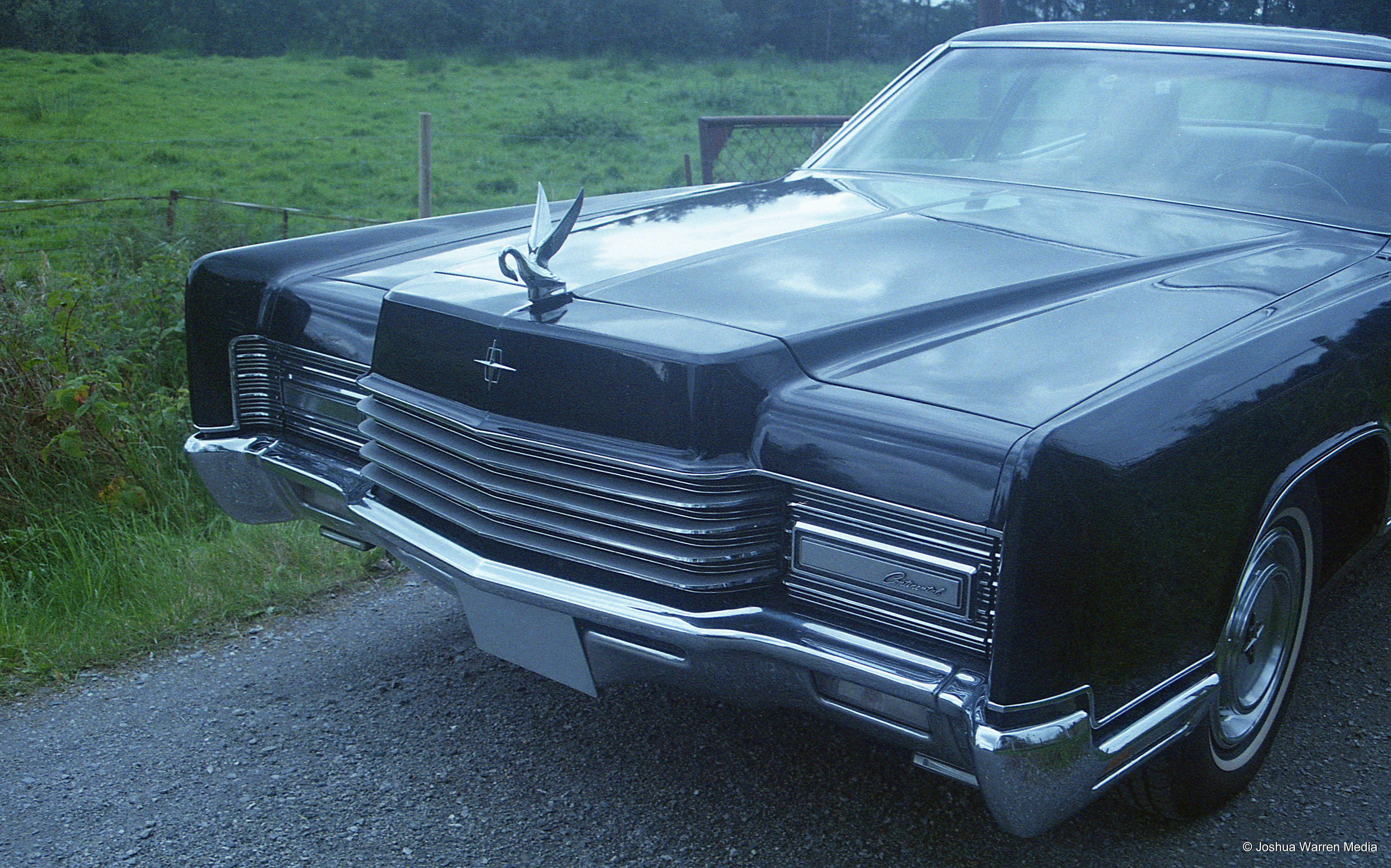
I eventually met up with Terje Tytland, the owner of a beautiful 1970 Ford Lincoln Continental. Though fairly different from the Chrysler described in the book, it did have that elongated and blocky silhouette that just screamed early 70s. If Marshall hadn’t gone for the Dodge Polara, this might have been his second choice. So, on an appropriately overcast day we took the car out to a country road where I snapped a few pictures of the car and he snapped a few of me stepping out of it.

A closer shot of the Ford Lincoln Continental that was not used in the trailer.


OILY GEODES

The meteorite shown in the trailer was another lucky no-budget solution. In 2008, while visiting some friends in the US, we went geode hunting in a stream in Illinois. During the drive we were given a rundown of what we might find—our “guides” had done this sort of thing many times before and had practically become experts—and explained that there were supposedly some geodes that contained raw oil, though they had never seen this. We hiked down to the stream, found several stones of varying sizes, cracked a few open, but one proved particularly tough, so we brought it back to our friends’ house and later that evening we took turns trying to break it open. The hammer passed from person to person, sparks literally flew from the rock as the hammer hit it, and eventually, as if it finally yielded to our curiosity, it neatly divided into two almost equally sized halves and a glob of black liquid splotched onto the pavement. It was actually filled with oil! You can still see dried up oil in the cracks of the odd, almost organic-looking interior of this strange geode, and we were told that the larger oil stain remained visible on the pavement for the better part of a year after we’d left.

Although the coarse, grey surface of this river rock is technically another incongruity with the novel, where it’s described as a smooth obsidian-like stone, it did fit most people’s preconception of what a meteorite should look like, and with its weird-looking interior revealed in cross-section, I decided to once again not squander a good opportunity with nitpicking.

The basement of my mother’s workplace just so happened to still have a bunch of furniture and random bits of equipment from the 70s and 80s scattered about, and provided a perfect backdrop for the scene where Bergström, also played by me, sneaks into the geology lab of the drill rig and places the stone on the table. Likewise, the rusty metal floor seen in the background when the stone is picked up (this time by my mother) was simply a small landing between two stairs near a restaurant a few blocks away from where I live that I felt had a nice industrial look to it. Yet another simple no-budget solution.

A normal river stone, a common geode, and a not so common geode. The black marks on the geode on the right are what's left of the crude oil.


THE CHILD

The last image seen in the trailer was actually one of the first things I photographed.

The solution was quite simple, though I must say, quite absurd looking in person. I purchased a baby doll from a second-hand store, got some black fishing line from a sports store, and I simply hung the doll from some air vents in the parking garage of the apartment building where I live. I suspended some black blankets with some old clothes hangers (and some tape) around one entrance to this little shortcut passage between two sections of the garage in order to block out the light from one side and to make sure that the bright light from the other would make the doll just a silhouette.

The end result was…passable. It was certainly strange.

But with some photoshopping it not only ended up looking quite retro, but had that surreal, X-Files inspired look that I was going for. In hindsight, though, there was so little left of the original aesthetic that I doubt if the B&W film made much of a difference.

Left: Probably one of the oddest BTS photos that has been taken of me. Right: The original B&W photo before it was photoshopped beyond recognition.


ODDS AND ENDS

Finally, just to be thorough, and in case some of you were wondering, here’s a brief explanation of the remaining photos that, in my opinion, didn’t have enough of a story behind them to warrant giving them their own section.

The house and the stairs representing the home of the kidnapped child were two separate locations, with the latter belonging to an artist friend of mine who not only lived in a house from the 70s but who collects all things odd and retro, such as the radio and the old Dole cardboard box that you can see at the bottom and top of the stairs. The house seen from the outside belongs to some old friends of my mother.

The stone circle is an actual pre-historic stone circle in Egersund which I have already written about in detail in my article about the Locations that Inspired The Starseed.

The two photos of the Aker H3 drill rig, and of the petroleum workers within, are historical stock photos generously provided by Norsk Oljemuseum (The Norwegian Petroleum Museum). 

And finally, though I did both the photo and the video editing myself, the rest of the post-production phase was largely done through people I know via The London Film Academy (the sound editing was done in Norway by Bibow Audio, who worked on both of my 2022 short films). The music was composed by Isabel Woodings, who was recommended to my by the co-producer and 2nd unit director of my short film Paradox, Oscar Hewitt, who on this project was also responsible for the voice-over recording.

The narration was done by voice actor David Mander, whom I discovered through an online casting process. The recording took place at the London Film Academy with Hewitt organising what can best be described as "long-distance-directing," meaning I directed the whole affair via Google Meet while Hewitt and Mander were together in the studio in London. Contrary to much of the analogue process used in the making of this trailer, this final step was a very modern solution that worked surprisingly well.


Featured post

THE STARSEED: A Professor Korrigan Mystery

  One night in 1975 a group of young men and women broke into a random house on the west-coast of Norway and abducted an infant child. A not...

Popular posts